


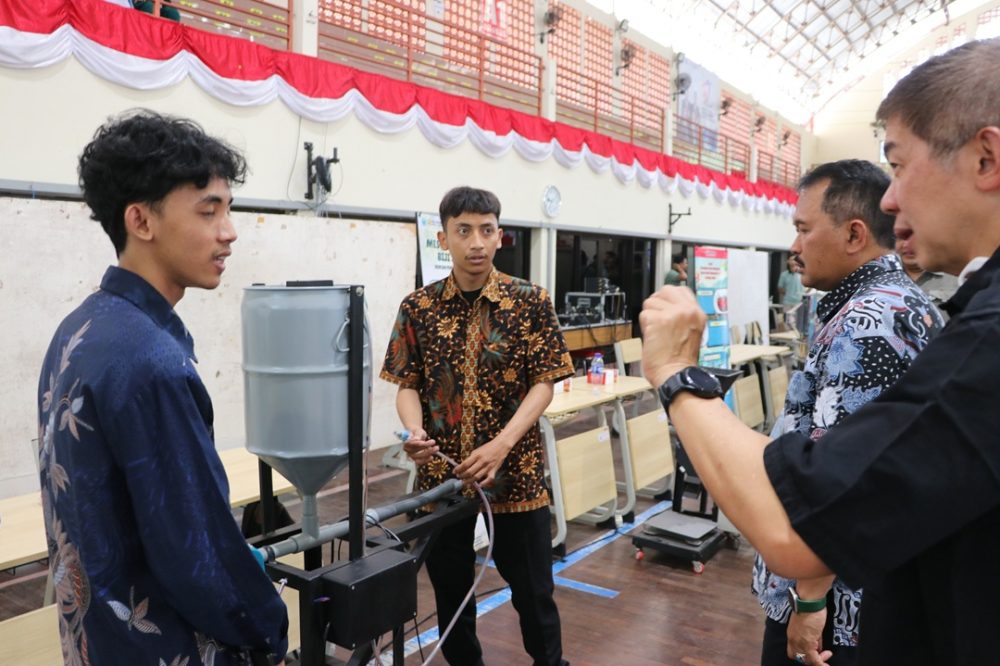
Polije Develops IoT Smart Fish Feeder for Fish Farming
JEMBER — Jember State Polytechnic (Polije) has developed an Internet of Things (IoT)-based Smart Fish Feeder. The innovation combines automatic feeding with real-time pond water quality monitoring.
Polije Engineering Department lecturer Ahmad Rofi’i, S.Pd., M.Pd., supervised the capstone research. He collaborated with four students: Bagus Pribadi, Muchammad Dito Firmansyah, Muhammad Ridwan Saputra, and Rizaldi Risqi Suciptop.
The system integrates scheduled feeding with temperature, pH, and water turbidity sensors. Its IoT technology also allows fish farmers to monitor pond conditions through a smartphone application.
“We designed this Smart Fish Feeder and water quality monitoring system to optimize fish growth. It also aims to reduce the risk of harvest failure caused by water fluctuations,” Ahmad Rofi’i said.
The team conducted functional tests on the temperature, pH, and turbidity sensors. According to Rofi’i, the test results showed that the sensors operated properly within the IoT system.
Student team member Bagus Pribadi explained the technology's benefits for fish farmers. “This technology has proven to improve feeding efficiency and provide greater convenience through remote monitoring,” Bagus said.
Besides simplifying feeding schedules, the device helps farmers monitor changes in pond water quality. They can identify potential problems earlier and determine appropriate responses.
Through this 2026 research project, Polije promotes automation technology for freshwater aquaculture. Further field testing remains necessary to measure feeding efficiency, sensor accuracy, and its impact on fish survival rates.
The Smart Fish Feeder offers potential to improve operational efficiency in fish farming. This innovation also strengthens Polije's contribution to developing applied technology for the fisheries sector.


