


Polije Helps Seputih Farmers Improve Robusta Coffee Quality
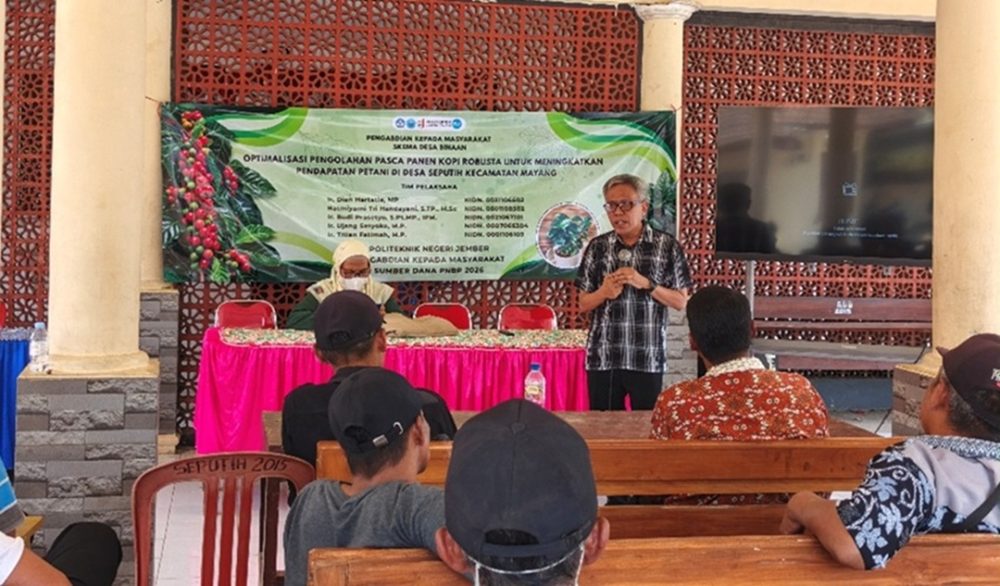
JEMBER — Lecturers from Jember State Polytechnic (Polije) assisted a coffee farmers’ group in Tetelan Hamlet, Seputih Village, Mayang District, Jember. The program focused on improving Robusta coffee post-harvest processing through training and hands-on practice.
The community service team consisted of Dian Hartatie, Hatmiyarni Tri Handayani, Ujang Setyoko, Budi Prasetyo, and Titien Fatimah. They provided guidance on coffee harvesting, green bean processing, drying, hulling, sorting, and ground coffee production.
The team encouraged farmers to adopt selective picking by harvesting only fully ripe red coffee cherries. They also advised farmers to separate unripe, damaged, rotten, and pest-infested cherries. Proper harvesting helps maintain the quality of raw materials.
“Farmers should process coffee cherries immediately, within 8–12 hours after harvesting. This helps preserve raw material quality and prevent deterioration,” Ujang Setyoko explained.
Farmers also learned to sort coffee cherries, remove their outer skins, and apply controlled fermentation. The process takes 12–36 hours, depending on environmental temperatures. They then wash the beans using clean water to prevent mold and maintain quality.
The team introduced simple drying methods using bamboo racks, tarpaulins, and drying shelves. Farmers dry the beans for 7–14 days and aim for a moisture content of approximately 12 percent. The team also provided solutions for limited hulling equipment through shared ownership, partnerships, or rental arrangements.
Beyond green bean production, Polije encouraged farmers to develop ground coffee products. Hatmiyarni Tri Handayani explained that local farmers mostly sell fresh cherries, parchment coffee, and some green beans. Processing coffee into ground products could increase added value and create new business opportunities.
The team also promoted appropriate technology that farmers could operate independently. “We hope communities will not only produce quality raw materials. They can also develop competitive processed products with higher economic value,” said Dian Hartatie, the program leader.
Through this initiative, Polije aims to improve farmers’ skills, processing efficiency, and the economic value of local Robusta coffee. The program also encourages greater independence among farmer groups and strengthens the competitiveness of locally processed coffee.


