


POLIJE Holds International Guest Lecture on Swiss Food Safety Requirements for Indonesian Exporters
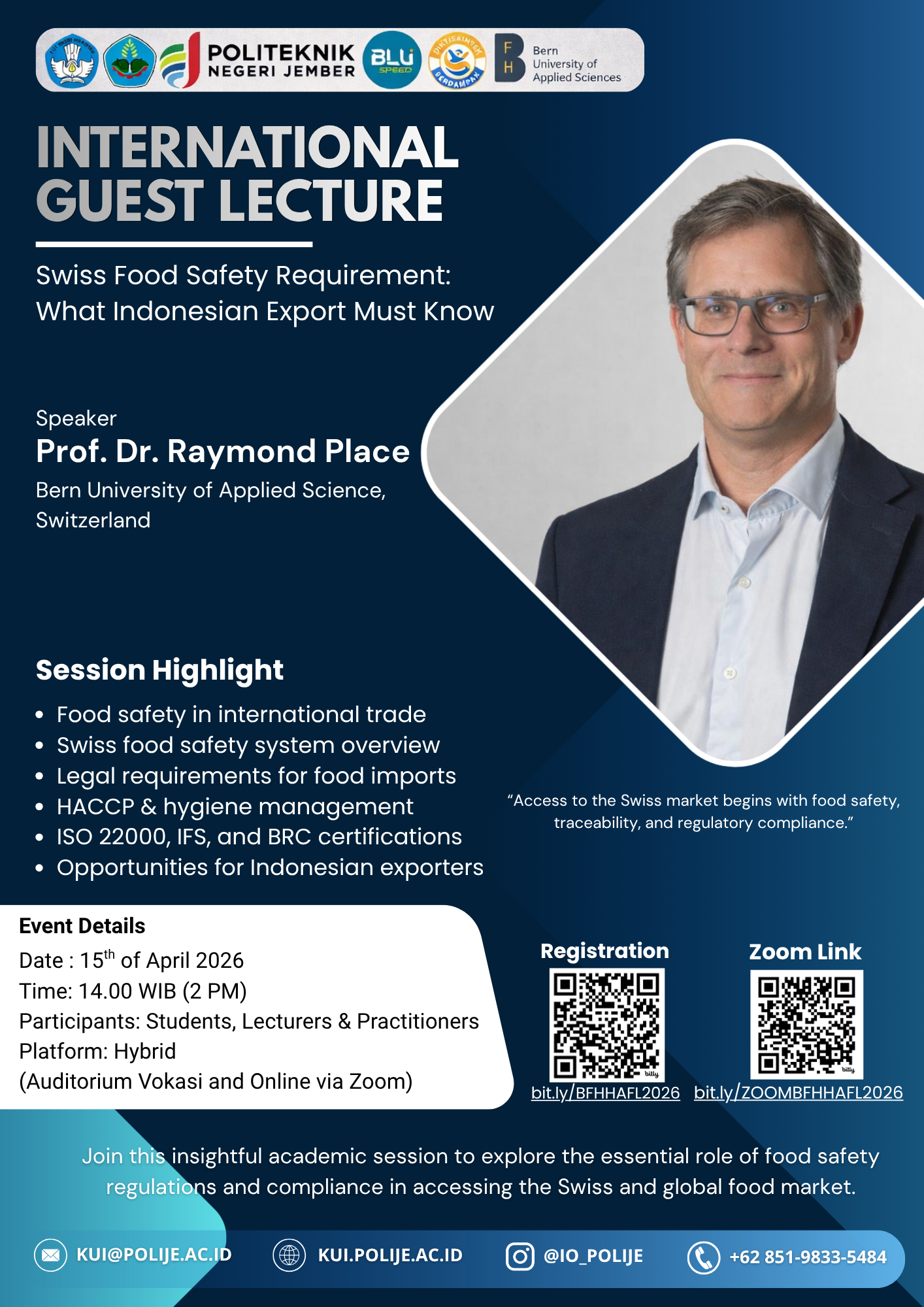
Jember, Indonesia — Politeknik Negeri Jember (POLIJE), through its international engagement and academic collaboration initiatives, successfully organized an International Guest Lecture featuring Prof. Dr. Raymond Place from Bern University of Applied Sciences, Switzerland, on 15 April 2026. The online event brought together students, lecturers, and practitioners to discuss the growing importance of food safety compliance in accessing international markets, particularly Switzerland and Europe.
The guest lecture, titled “Swiss Food Safety Requirement: What Indonesian Export Must Know,” was designed to provide participants with practical and strategic insights into the regulatory landscape governing food exports to Switzerland. As global trade becomes increasingly competitive and regulated, the event highlighted the need for Indonesian exporters and future agribusiness professionals to understand international standards and consumer expectations.
In his presentation, Prof. Dr. Raymond Place introduced participants to the fundamental structure of the Swiss food safety system, emphasizing the country’s strict commitment to public health, product traceability, and legal compliance. He explained that food entering the Swiss market must not only meet quality expectations but also satisfy rigorous safety protocols throughout the production and supply chain process.
One of the major topics discussed during the session was the legal and technical requirements for food imports into Switzerland. Participants were introduced to the role of hygiene standards, inspection systems, documentation, labeling, and product traceability in ensuring export readiness. Prof. Place underlined that access to premium international markets begins with trust, and that trust is built through transparent and well-documented food safety systems.
The lecture also focused on internationally recognized food safety frameworks such as HACCP (Hazard Analysis and Critical Control Points), ISO 22000, IFS, and BRC certifications. These standards, according to Prof. Place, are increasingly becoming essential references for producers and exporters seeking long-term access to global food supply chains. He encouraged students and industry stakeholders to view certification not merely as an administrative requirement, but as a strategic investment in market credibility and competitiveness.
Another important discussion centered on the opportunities available for Indonesian exporters, particularly in the fields of processed food, agricultural products, and value-added commodities. Prof. Place noted that Indonesia possesses strong export potential due to its rich agricultural diversity, but he also stressed that product quality alone is not enough. Exporters must be prepared to meet international expectations regarding food handling, safety assurance, and sustainable production practices.
The event attracted enthusiastic participation from students, lecturers, and practitioners, reflecting the growing interest in international trade and food industry standards among the academic and professional community. During the interactive discussion session, participants raised questions related to export preparation, certification processes, challenges faced by small and medium enterprises, and the role of higher education institutions in preparing globally competent graduates.
Through this international academic forum, POLIJE reaffirmed its commitment to strengthening global partnerships and expanding students’ exposure to real-world international issues. The collaboration with Bern University of Applied Sciences is expected to contribute to broader academic and professional exchanges, especially in areas related to applied sciences, food technology, agribusiness, and international trade.
This guest lecture also aligns with POLIJE’s broader mission to support the development of industry-relevant competencies and to equip students with the knowledge needed to thrive in international environments. By inviting experts from reputable overseas institutions, the university continues to create meaningful learning opportunities that bridge theory, policy, and practice.
With food safety and regulatory compliance becoming key determinants of export success, the session served as a timely reminder that academic institutions have an important role to play in preparing future professionals for global challenges. The International Guest Lecture was not only an academic event, but also a platform for inspiring innovation, strengthening international awareness, and encouraging Indonesian stakeholders to pursue higher standards in food production and export readiness.


