


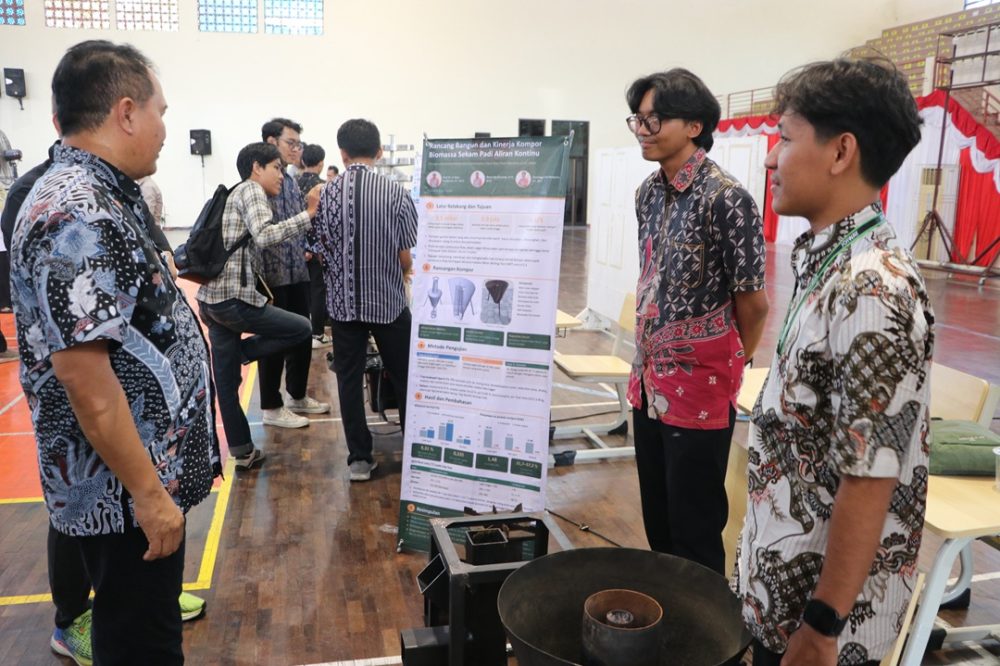
Polije Team Develops Continuous-Feed Rice Husk Biomass Stove
JEMBER — Jember State Polytechnic (Polije) is developing a biomass stove that uses rice husks as fuel and features a continuous-feed system. The technology allows users to add fuel while the stove remains in operation, eliminating the need to shut it down and restart the heating process.
The development is led by Prof. Dr. Ir. Bayu Rudiyanto, S.T., M.Si., alongside fellow Polije researchers Warit Abi Nurazaq, S.T.P., M.Sc., and Novangga Adi Mulyono, S.T., M.T.
The stove features a cone-shaped hopper that stores and feeds rice husks into the combustion chamber. This design enables continuous fuel supply, helping users maintain the heating process without repeatedly restarting the stove.
“We designed this biomass stove to turn rice husk waste into an efficient and clean cooking energy source,” Bayu Rudiyanto said.
To evaluate the stove’s performance, the research team conducted tests using the Water Boiling Test (WBT) version 4.2.3. This method allowed the researchers to assess the stove’s thermal performance during the water-heating process.
Bayu explained that the continuous-feed mechanism helps maintain the heating process. “The continuous-flow system keeps the heating process stable without requiring users to restart the stove from the beginning,” he added.
The test results showed that the stove achieved a thermal efficiency of 12.70 percent during the hot-start phase. In addition, the stove incorporates a thermal insulation chamber designed to keep its outer walls cool during operation.
The innovation also offers a way to increase the value of rice husks, an agricultural by-product that is often underutilized. By using this material as fuel, the stove could help communities make better use of locally available resources.
Through this research, Polije continues to develop appropriate technologies that support renewable energy use and resource efficiency. Further testing is still needed to evaluate the stove’s efficiency, safety, and suitability for wider adoption.
The team hopes the technology will provide an alternative cooking solution while encouraging the productive use of agricultural waste.


