


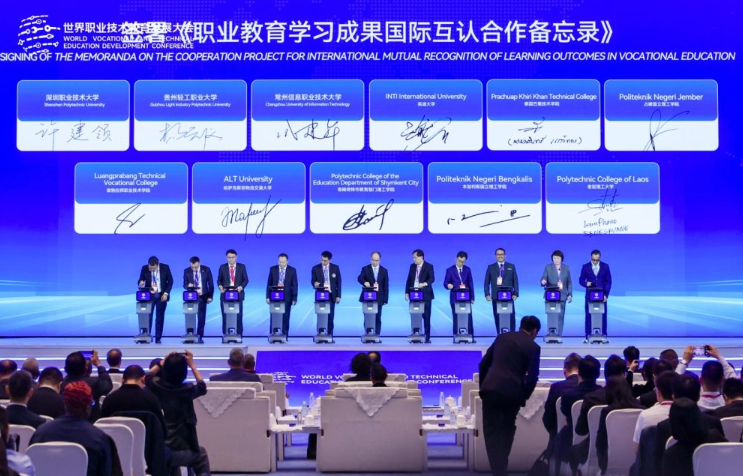
POLIJE Signs MoU with Shenzhen Polytechnic University at World Vocational Education Conference in China
TIANJIN, CHINA – Politeknik Negeri Jember (POLIJE), Indonesia, has strengthened its international cooperation by signing a Memorandum of Understanding (MoU) with Shenzhen Polytechnic University, China, during the World Vocational and Technical Education Development Conference held in Tianjin, China, from October 15 to 17, 2026. The agreement marks an important step in expanding POLIJE’s international network and strengthening collaboration in vocational education.
The conference brought together more than 700 representatives from various countries to discuss the development of vocational and technical education. Agung Wahyono, S.P., M.Si., Ph.D., Vice Director for Cooperation and Public Relations at POLIJE, attended the event at the invitation of Shenzhen Polytechnic University. The participation provided an opportunity for POLIJE to engage with international institutions and explore new possibilities for academic collaboration.
POLIJE and Politeknik Negeri Bengkalis were the two Indonesian polytechnics that signed MoUs during the forum. Through this agreement, POLIJE aims to broaden its partnerships with vocational higher education institutions in China and create opportunities for collaborative programs that support institutional development and academic excellence.
Agung Wahyono emphasized the importance of the agreement in strengthening POLIJE’s international presence. “The signing of this MoU is an important step toward expanding POLIJE’s international cooperation network, particularly with vocational higher education institutions in China,” he stated. POLIJE has previously established connections with several Chinese educational partners, including institutions in Jiangsu, Changzhou, and Wuxi.
POLIJE Director Saiful Anwar, S.TP., M.P., expressed his appreciation to Shenzhen Polytechnic University for the invitation and the opportunity to strengthen relations between the two institutions. “It is an honor for POLIJE to be here with you all in Tianjin for the World Conference on Vocational Education. I would like to express my sincere gratitude to the President and leadership of Shenzhen Polytechnic University for inviting POLIJE to participate in this important event,” he said.
Saiful Anwar also highlighted Shenzhen Polytechnic University’s role as a benchmark for innovation and development in vocational education. He noted that collaboration between the two institutions could help address the challenges posed by technological advancements and digital transformation. By exchanging expertise and experiences, both institutions can enhance the relevance and quality of vocational education in response to changing global demands.
To translate the agreement into practical outcomes, Saiful proposed three priority areas for collaboration. The first is student exchange, which would provide students with international learning experiences and broader global perspectives. The second is lecturer training and development, aimed at strengthening teaching competencies through professional exchanges and knowledge sharing between the institutions.
The third priority is collaborative applied research and curriculum alignment with global industry needs. Through joint research initiatives and the development of industry-relevant curricula, POLIJE and Shenzhen Polytechnic University aim to strengthen the connection between education and the professional workplace. These initiatives are expected to help students acquire practical skills and competencies that meet the evolving demands of the international labor market.
“By combining our expertise, experience, and potential, we can build a vocational education and training ecosystem that is ready to face future challenges while directly connecting education with the needs of global industries,” Saiful explained. His statement reflects POLIJE’s commitment to developing vocational education that integrates academic learning, practical training, innovation, and industry collaboration.
Following the MoU signing, POLIJE hopes that both institutions will promptly follow up on the agreement through concrete and sustainable joint programs. The planned collaboration is expected to benefit students, lecturers, and both institutions by expanding international learning opportunities, improving human resource competencies, and strengthening applied research. This partnership also represents POLIJE’s continued commitment to internationalization and to preparing graduates who are competitive in an increasingly interconnected global environment.


