


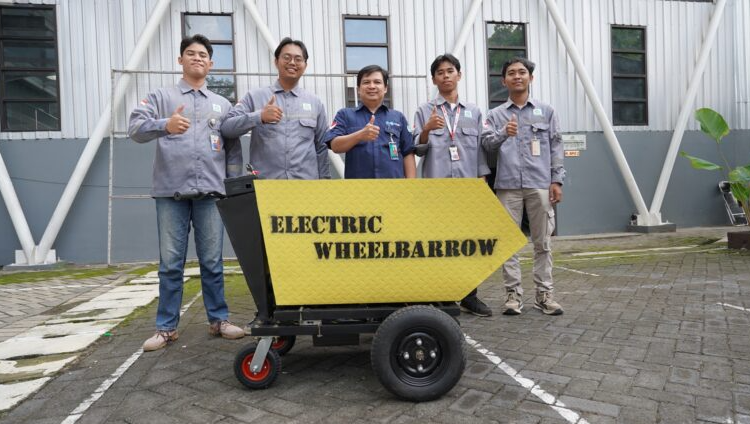
Polije Students Develop Electric Wheelbarrow to Ease Harvest Transportation for Farmers
Students from the Engineering Department of Politeknik Negeri Jember (Polije) have successfully developed an innovative electric wheelbarrow designed to assist farmers in transporting heavy loads more efficiently. The technology was created as a practical solution to one of the most common challenges faced by farmers—moving harvested crops across difficult terrain, particularly on uphill paths.
The innovation was developed by student inventor Rivaldi Gilang Pramana and his team as part of Polije’s commitment to creating applied technologies that directly address community needs. Unlike conventional wheelbarrows that rely entirely on human strength, the electric version utilizes a motorized system to significantly reduce physical effort and improve productivity in agricultural operations.
At the heart of the machine is a 500-watt electric motor that provides sufficient power to carry heavy agricultural loads while navigating sloped and uneven surfaces. The motorized assistance allows farmers to transport harvested products more easily, helping reduce fatigue and increasing operational efficiency during harvest periods.
Beyond its electric propulsion system, the wheelbarrow incorporates a digital weighing feature using load-cell technology. This system enables users to measure the weight of harvested crops directly during transportation, eliminating the need for separate weighing processes and improving workflow efficiency.
One of the innovation’s most advanced features is its digital connectivity. Weight measurement data can be monitored through a smartphone and automatically stored on an SD card. This capability allows farmers to record harvest data digitally, making crop management and production monitoring more accurate and convenient.
The project received strong support from supervising lecturer Mochamad Irwan Nari, who emphasized the importance of developing technologies that provide practical benefits to society. He noted that vocational education should encourage students to create solutions that are not only innovative but also directly applicable to real-world challenges faced by farmers and rural communities.
Although the prototype has demonstrated significant potential, the development team continues to refine the design before moving toward large-scale production. Planned improvements include the addition of a seating feature that would allow operators to ride the wheelbarrow rather than walk alongside it, further enhancing comfort and usability.
The Electric Wheelbarrow represents another example of Polije’s dedication to fostering innovation in the agricultural sector. By combining engineering expertise with practical agricultural needs, the institution continues to empower students to create technologies that support modern farming, improve productivity, and contribute to the advancement of sustainable agriculture in Indonesia.


