


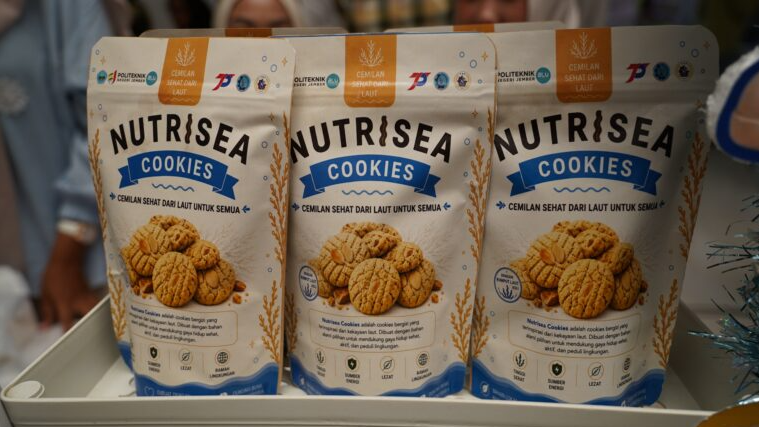
POLIJE Students Transform Seaweed into High-Value Functional Cookies
Students from the Food Engineering Technology Study Program (TRP), Department of Agricultural Technology, Politeknik Negeri Jember (POLIJE), have developed an innovative functional food product called Nutrisea Cookies, demonstrating how Indonesia's abundant marine resources can be transformed into value-added products. The cookies are made from Eucheuma spinosum seaweed flour, offering a nutritious alternative while promoting the downstream utilization of local commodities.
The innovation was initiated by Ivan Andrean Alfariji and five fellow students who were motivated by the fact that a significant portion of Indonesia's seaweed production is still exported as raw material. Their project aims to increase the economic value of seaweed by converting it into a commercially attractive food product with greater market potential.
To ensure the product met consumer expectations, the student team employed Quality Function Deployment (QFD) and the House of Quality (HOQ) approach during product development. These analytical methods enabled the team to translate consumer preferences into technical product specifications, resulting in cookies with desirable taste, texture, and nutritional quality.
Nutrisea Cookies are designed as a functional snack that is naturally rich in dietary fiber and antioxidants. By utilizing seaweed as the primary ingredient, the product addresses the growing demand for healthier snack alternatives while highlighting the nutritional benefits of Indonesia's marine resources. The innovation also reflects increasing consumer interest in sustainable and health-oriented food products.
Beyond creating a new food product, the project demonstrates POLIJE's commitment to project-based learning and applied research. Through this initiative, students integrated scientific knowledge, food technology, product innovation, and market analysis to develop a solution with real commercial potential. The experience strengthened both their technical competencies and entrepreneurial mindset.
The Department of Agricultural Technology has expressed strong support for the innovation and hopes the product can be further developed for commercial-scale production. The university views Nutrisea Cookies as an excellent example of how vocational education can generate practical innovations that respond directly to industry needs while maximizing the utilization of local natural resources.
The development of Nutrisea Cookies also contributes to Indonesia's broader agenda of strengthening the downstream processing of marine commodities. Rather than exporting seaweed as a raw material, the innovation demonstrates how value-added food processing can enhance competitiveness, create new business opportunities, and improve the economic returns of local agricultural and marine products.
Through Nutrisea Cookies, POLIJE students have shown that innovation, sustainability, and entrepreneurship can work together to create impactful solutions. The project not only promotes healthier food choices but also showcases the important role of vocational higher education in advancing food innovation, supporting local industries, and encouraging young innovators to unlock the full potential of Indonesia's natural resources.


