


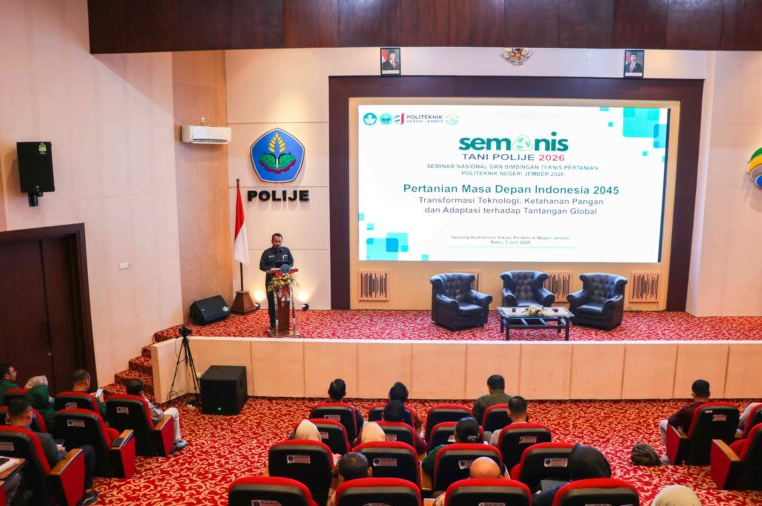
SEMANIS TANI 2026: Polije’s Agricultural Production Department Supports Indonesia Emas Vision
The Agricultural Production Department of Politeknik Negeri Jember (Polije) successfully organized SEMANIS TANI 2026 (National Agricultural Seminar and Technical Guidance), reaffirming its commitment to advancing Indonesia’s agricultural sector and supporting the nation’s long-term development agenda toward Indonesia Emas 2045. The annual event, now in its seventh edition, brought together academics, government representatives, industry practitioners, and students to discuss innovations and strategies for sustainable agricultural development.
The event was officially opened by Saiful Anwar, Director of Polije, who emphasized the strategic role of vocational higher education institutions in preparing highly skilled agricultural human resources. He highlighted that strengthening the quality of agricultural professionals is essential for addressing increasingly complex global challenges, including food security, climate change, and technological transformation.
According to the Director, vocational education institutions have a unique advantage because they focus on practice-based learning. Through hands-on training, industry collaboration, and applied research, vocational universities can equip students with the competencies needed to drive innovation and productivity in the agricultural sector.
Head of the Agricultural Production Department, Dwi Rahmawati, explained that SEMANIS TANI 2026 was intentionally designed as a collaborative forum involving stakeholders from various sectors. By bringing together researchers, policymakers, entrepreneurs, and practitioners, the event aimed to foster synergy and generate innovative solutions that can contribute to the future of Indonesian agriculture.
One of the key themes discussed during the seminar was the importance of human resource development as the foundation for agricultural transformation. Participants explored how innovation, technology adoption, and competency-based education can improve agricultural productivity while ensuring sustainability and competitiveness in global markets.
The event also featured technical guidance sessions and parallel discussions focusing on practical agricultural technologies. These sessions provided participants with opportunities to learn about modern cultivation methods, precision agriculture, seed technology, plantation management, and other innovations that can be directly implemented in the field.
According to the organizing committee, SEMANIS TANI 2026 attracted hundreds of participants from 23 provinces across Indonesia. The hybrid format enabled broader participation while facilitating knowledge exchange among agricultural stakeholders from diverse regions. In addition to seminar sessions, the event showcased innovative products and projects developed by students through Polije’s applied learning programs.
Through SEMANIS TANI 2026, Polije continues to demonstrate its commitment to becoming a center of agricultural innovation and vocational excellence. By strengthening collaboration, promoting technology adoption, and developing highly competent agricultural professionals, the institution contributes to building a resilient and sustainable agricultural sector that supports the realization of Indonesia Emas 2045.


